
Blog
The History of Steroids in Medicine and Sport
Jul
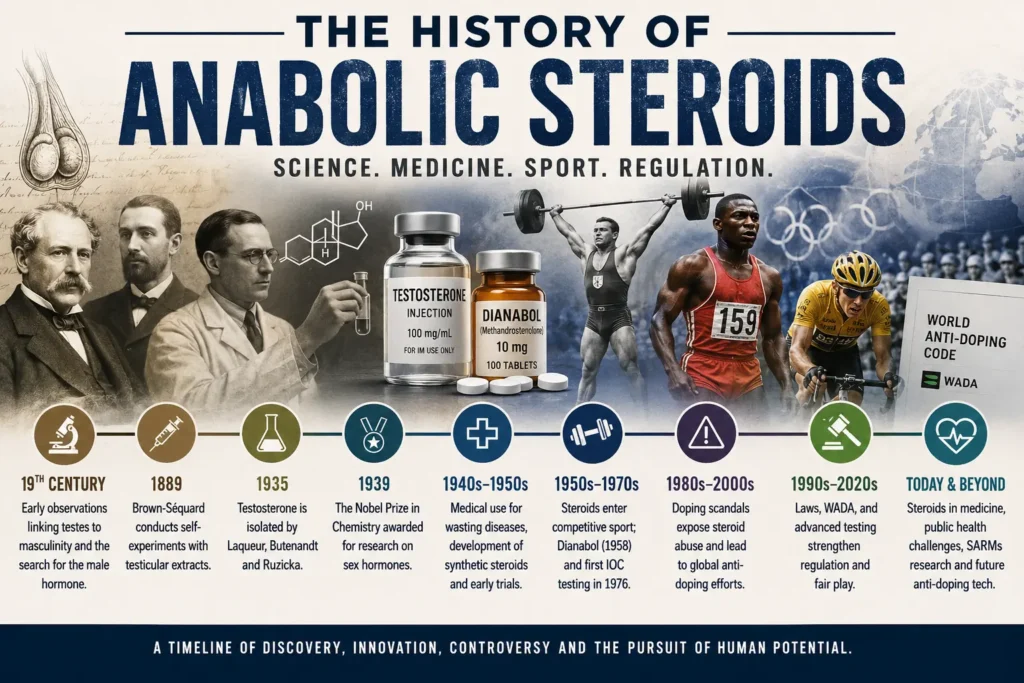
History of Anabolic Steroids: From Early Hormone Research to Modern Medicine and Sports
| Grizzly Steroids. From the 1935 discovery of testosterone to modern anti-doping policy, explore the history
of steroids in medicine and competitive sport. |
The history of anabolic steroids spans more than a century of scientific discovery, medical innovation, athletic achievement, and regulatory evolution. What began as a search to understand the male hormone eventually transformed modern endocrinology, improved treatments for hormone deficiencies, and significantly influenced competitive sports.
Today, anabolic-androgenic steroids (AAS) remain valuable prescription medicines for several medical conditions. However, their misuse in athletics and recreational bodybuilding has also shaped public perception and led to extensive anti-doping efforts worldwide.
This article explores the complete history of anabolic steroids, highlighting the scientists, discoveries, sporting milestones, and legal developments that have defined their journey.
Early Endocrinology: The Search for the Male Hormone
Understanding Masculinity in the 19th Century
Long before scientists understood hormones, physicians noticed an obvious biological relationship between the testes and male development. Throughout the 19th century, researchers observed that males who lost testicular function before puberty often failed to develop typical masculine characteristics such as:
- Deep voice
- Facial hair
- Increased muscle mass
- Higher bone density
- Male reproductive function
These observations inspired early endocrinologists to search for the mysterious substance responsible for male development.
Although hormones had not yet been identified, scientists suspected that the testes released a powerful chemical messenger into the bloodstream.
This curiosity laid the foundation for modern hormone research.
Brown-Séquard’s Famous Self-Experiments (1889)
One of the most controversial chapters in endocrine history involved the French physiologist Charles-Édouard Brown-Séquard.
In 1889, at the age of 72, Brown-Séquard announced that he had injected himself with extracts made from dog and guinea pig testicles.
He claimed remarkable improvements, including:
- Increased physical strength
- Better mental clarity
- Greater energy
- Enhanced sexual performance
Although later research showed that these extracts contained virtually no active testosterone, Brown-Séquard’s work generated enormous public interest.
More importantly, his experiments inspired scientists worldwide to investigate internal secretions—the concept later known as hormones.
Many historians consider these experiments the unofficial beginning of modern hormone therapy.
The Race to Isolate Testosterone (1935)
By the early 20th century, scientists knew the testes produced a biologically active substance. However, isolating it proved extremely difficult because only tiny amounts existed within testicular tissue.
The breakthrough finally arrived in 1935.
Several research teams independently succeeded in isolating and synthesizing testosterone.
The most influential scientists included:
Ernst Laqueur
Working in the Netherlands, Laqueur successfully isolated testosterone from bull testes.
His work demonstrated the hormone’s chemical identity and biological activity.
Adolf Butenandt
German chemist Adolf Butenandt independently synthesized testosterone and made major contributions to understanding steroid hormones.
His research also advanced knowledge of estrogen and progesterone.
Leopold Ruzicka
Swiss chemist Leopold Ruzicka developed improved methods for synthesizing testosterone on an industrial scale.
His techniques allowed pharmaceutical companies to begin producing testosterone for medical use.
The 1939 Nobel Prize in Chemistry
The significance of these discoveries became clear only a few years later.
In 1939, Adolf Butenandt and Leopold Ruzicka shared the Nobel Prize in Chemistry for their pioneering work on sex hormones.
Their discoveries marked one of the most important milestones in endocrinology.
Without this research, modern hormone replacement therapy, fertility medicine, and anabolic steroid development would not exist.
Wartime and Early Medical Applications (1940s–1950s)
Treating Malnutrition and Muscle Wasting
During and after World War II, physicians searched for treatments that could help severely malnourished soldiers recover more quickly.
Testosterone showed remarkable anabolic—or tissue-building—properties.
Doctors began using testosterone to support patients with:
- Severe burns
- Major surgery recovery
- Muscle wasting
- Chronic illness
- Delayed puberty
- Hypogonadism
Researchers observed improvements in:
- Nitrogen retention
- Muscle growth
- Bone development
- Recovery speed
These therapeutic benefits remain medically important today.
Development of Early Synthetic Analogs
Natural testosterone worked well medically but presented several practical challenges.
Scientists therefore began modifying its molecular structure.
The goals included:
- Longer duration
- Better oral availability
- Reduced androgenic effects
- Greater anabolic activity
These efforts produced the first generation of anabolic steroids.
Examples included:
- Methandrostenolone (Dianabol)
- Nandrolone
- Oxymetholone
- Stanozolol
Each compound offered different anabolic-to-androgenic ratios and pharmacological characteristics.
Pharmaceutical Industry Expansion
By the 1950s, pharmaceutical companies invested heavily in steroid research.
Manufacturers explored new treatments for:
- Osteoporosis
- Anemia
- Growth disorders
- Chronic infections
- Recovery after surgery
Clinical trials expanded rapidly.
Many anabolic steroids were initially developed with legitimate therapeutic intentions before later becoming associated with athletic performance enhancement.
Steroids Enter Competitive Sport (1950s–1970s)
The Soviet Weightlifting Team (1952 Olympics)
One of the most frequently discussed moments in sports history occurred during the early Olympic weightlifting competitions.
Reports suggested that members of the Soviet weightlifting team were using testosterone to improve strength and recovery.
Although documentation remains incomplete, these reports attracted significant attention among Western physicians and coaches.
Whether entirely accurate or partly anecdotal, they influenced future research into performance enhancement.
Dr. John Ziegler and Dianabol (1958)
American physician Dr. John Ziegler became interested in improving athlete performance after learning about testosterone use among international competitors.
Working with pharmaceutical researchers, he helped develop Methandrostenolone, marketed as Dianabol.
Released in 1958, Dianabol became the first widely used oral anabolic steroid.
Athletes quickly appreciated its ability to:
- Increase muscle size
- Improve recovery
- Enhance training capacity
- Increase strength
Its popularity spread rapidly throughout competitive sports.
Expansion Across Sports
Throughout the 1960s and early 1970s, anabolic steroid use expanded into numerous sports.
These included:
- Bodybuilding
- Olympic weightlifting
- Track and field
- American football
- Professional wrestling
- Throwing events
- Powerlifting
During this era, steroids remained largely unregulated, and testing methods were either unavailable or ineffective.
First IOC Drug Testing (1976 Montreal Olympics)
Growing concern over performance-enhancing drugs eventually prompted action.
The International Olympic Committee introduced anabolic steroid testing during the 1976 Montreal Olympics.
This marked the first major international effort to detect steroid use in elite athletes.
Testing technology would continue improving over the following decades.
The Doping Era and Major Scandals
The East German State Doping Program
Perhaps no chapter in steroid history is more controversial than East Germany’s government-sponsored doping program.
Beginning in the 1960s, thousands of athletes reportedly received anabolic steroids as part of a state-directed initiative to improve international sporting success.
Many athletes later reported serious long-term health consequences.
Following German reunification, government records revealed the scale of the program, making it one of the most extensively documented doping systems in sports history.
Ben Johnson and the 1988 Seoul Olympics
The 1988 Olympic Games became one of the most famous doping scandals ever recorded.
Canadian sprinter Ben Johnson won the men’s 100-meter final in world-record time.
Only days later, he tested positive for stanozolol.
His medal was revoked, and the incident dramatically increased global awareness of anabolic steroid misuse.
The scandal also accelerated improvements in anti-doping enforcement.
The BALCO Investigation
During the early 2000s, investigators uncovered the BALCO scandal involving designer performance-enhancing drugs.
One of the most notable compounds was THG (tetrahydrogestrinone).
THG had been specifically engineered to avoid existing laboratory tests.
The investigation led to improved analytical techniques and highlighted the ongoing challenge of detecting newly developed anabolic agents.
EPO and the Tour de France
Although erythropoietin (EPO) is not an anabolic steroid, it became closely associated with professional cycling during the late 1990s and early 2000s.
High-profile doping cases in the Tour de France demonstrated that athletes often combined multiple performance-enhancing substances.
These events encouraged broader anti-doping strategies that addressed a wide range of prohibited compounds.
Regulatory and Legal Milestones
US Anabolic Steroid Control Act of 1990
Public concern over steroid misuse eventually resulted in legislative action.
The United States passed the Anabolic Steroid Control Act in 1990.
This law classified many anabolic steroids as controlled substances, increasing legal penalties for unauthorized possession and distribution.
It also established stricter oversight of prescribing practices.
World Anti-Doping Agency (WADA) – 1999
In response to widespread international doping concerns, the World Anti-Doping Agency (WADA) was established in 1999.
WADA coordinates:
- Global anti-doping standards
- Accredited laboratories
- Testing protocols
- Athlete education
- Scientific research
Today, WADA remains the leading international authority on anti-doping policy.
Athlete Biological Passport (2008)
Traditional drug testing detects specific prohibited substances.
The Athlete Biological Passport introduced a different strategy.
Instead of searching for individual drugs, it monitors biological markers over time.
Abnormal changes may indicate doping even when a specific substance cannot be directly detected.
This innovation significantly strengthened modern anti-doping programs.
Designer Anabolic Steroid Control Act (2014)
As underground laboratories created increasingly sophisticated steroid analogs, legislators updated existing laws.
The Designer Anabolic Steroid Control Act of 2014 expanded the list of prohibited substances and simplified the prosecution of newly developed anabolic compounds designed to evade regulation.
Steroids Today: Medicine and Public Health
The Rise of Testosterone Replacement Therapy (TRT)
In recent years, prescriptions for testosterone replacement therapy (TRT) have increased substantially.
Appropriately prescribed TRT may benefit men with confirmed hypogonadism by improving:
- Bone density
- Muscle mass
- Energy levels
- Sexual function
- Overall quality of life
However, medical guidelines recommend diagnosis based on both clinical symptoms and laboratory testing rather than age alone.
The increased public awareness of “low T” has also fueled discussions about appropriate prescribing practices and long-term monitoring.
Recreational Use Beyond Elite Sports
Modern anabolic steroid use is no longer limited to professional athletes.
Research suggests many users now participate in recreational fitness, bodybuilding, or appearance-focused training rather than organized competition.
This shift has prompted greater attention to public health, education, and harm-reduction strategies.
Healthcare providers increasingly encounter individuals seeking advice on the risks associated with non-medical AAS use.
The Emergence of SARMs
Scientists continue developing selective androgen receptor modulators (SARMs).
These experimental compounds aim to provide some anabolic benefits while reducing unwanted androgenic effects.
Although several SARMs remain under investigation for medical conditions involving muscle loss, none has yet fulfilled the early expectations of becoming a complete replacement for traditional anabolic steroids.
Many products marketed as SARMs online are also unapproved for medical use, and their quality can vary.
The Future of Anti-Doping Technology
Anti-doping science continues evolving alongside advances in pharmacology.
Future detection methods may include:
- Artificial intelligence-assisted screening
- Improved mass spectrometry
- Long-term biomarker analysis
- Genetic and molecular testing
- Enhanced Athlete Biological Passport models
Researchers are also studying ways to identify emerging performance-enhancing substances more rapidly while protecting athlete privacy and maintaining fair competition.
Conclusion
The history of anabolic steroids reflects the intersection of scientific discovery, medical progress, competitive sports, and public policy. From early observations about male physiology in the 19th century to the isolation of testosterone in 1935, anabolic steroids have played an important role in advancing endocrinology and the treatment of hormone-related conditions.
At the same time, their misuse in sport led to major scandals, stricter regulations, and the creation of sophisticated anti-doping programs. Today, anabolic steroids remain valuable medications when prescribed for appropriate medical indications, while ongoing research into therapies such as SARMs and improvements in detection technology continue to shape the future.
Understanding the history of anabolic steroids provides valuable context for informed discussions about their legitimate medical uses, potential risks, and evolving role in healthcare and athletics.
Frequently Asked Questions
When were anabolic steroids first discovered?
Testosterone was successfully isolated and synthesized in 1935 by several research teams, marking the beginning of modern anabolic steroid development.
Who invented Dianabol?
Methandrostenolone (Dianabol) was developed in the late 1950s with contributions from Dr. John Ziegler and pharmaceutical researchers, and it became one of the first widely used oral anabolic steroids.
Why were anabolic steroids created?
They were developed to treat legitimate medical conditions such as hypogonadism, delayed puberty, muscle wasting, anemia, and recovery from severe illness or injury.
When did steroid testing begin in the Olympics?
The International Olympic Committee introduced testing for anabolic steroids at the 1976 Montreal Olympic Games.
Are anabolic steroids still used in medicine?
Yes. Under medical supervision, anabolic steroids and testosterone-based therapies continue to be prescribed for specific conditions, including testosterone deficiency and certain muscle-wasting disorders.
